


Pre-salt
An extensive oil and gas reserve located below a thick layer of salt. Learn more about pre-salt.
Do a search:
Most searched
Fuel price
Pre-salt
Team Petrobras

The pre-salt reserves occupy an area of approximately 150,000 km², between the states of Santa Catarina and Espírito Santo. The production fields are located mainly in two basins: Santos Basin and Campos Basin. The total depth—the distance between the sea surface and oil reservoirs below the salt layer—can reach 7,000 meters.
For pre-salt production, Petrobras uses floating platforms of the FPSO type (Floating Production Storage and Offloading units). In general, the wells show high productivity.
This is the country's largest oil-producing field. Its reservoir has a thickness of up to 480 meters and an extension of 852 km².
Brazil's largest oil platform is also located in Búzios: the FPSO Almirante Tamandaré, with a capacity to produce up to 225,000 barrels of oil per day (bpd).
Here the first High-Pressure Subsea Separation System (HiSEP®) will be deployed, which, after self-consumption in the FPSO, reinjects all gas production with 45% CO2 content into the reservoir.
It is located in the northwest portion of the Libra block, where we operate in consortiums with other sector companies. Current production of approximately 650,000 barrels per day.
This is where we extracted the first oil from the pre-sal in the Santos Basin.
Tupi/Iracema production has one of the lowest emission levels in the global industry, 9.7 KgCO2e/boe.
Sixteen new wells are planned until 2030, with 12 producers and 4 injectors.
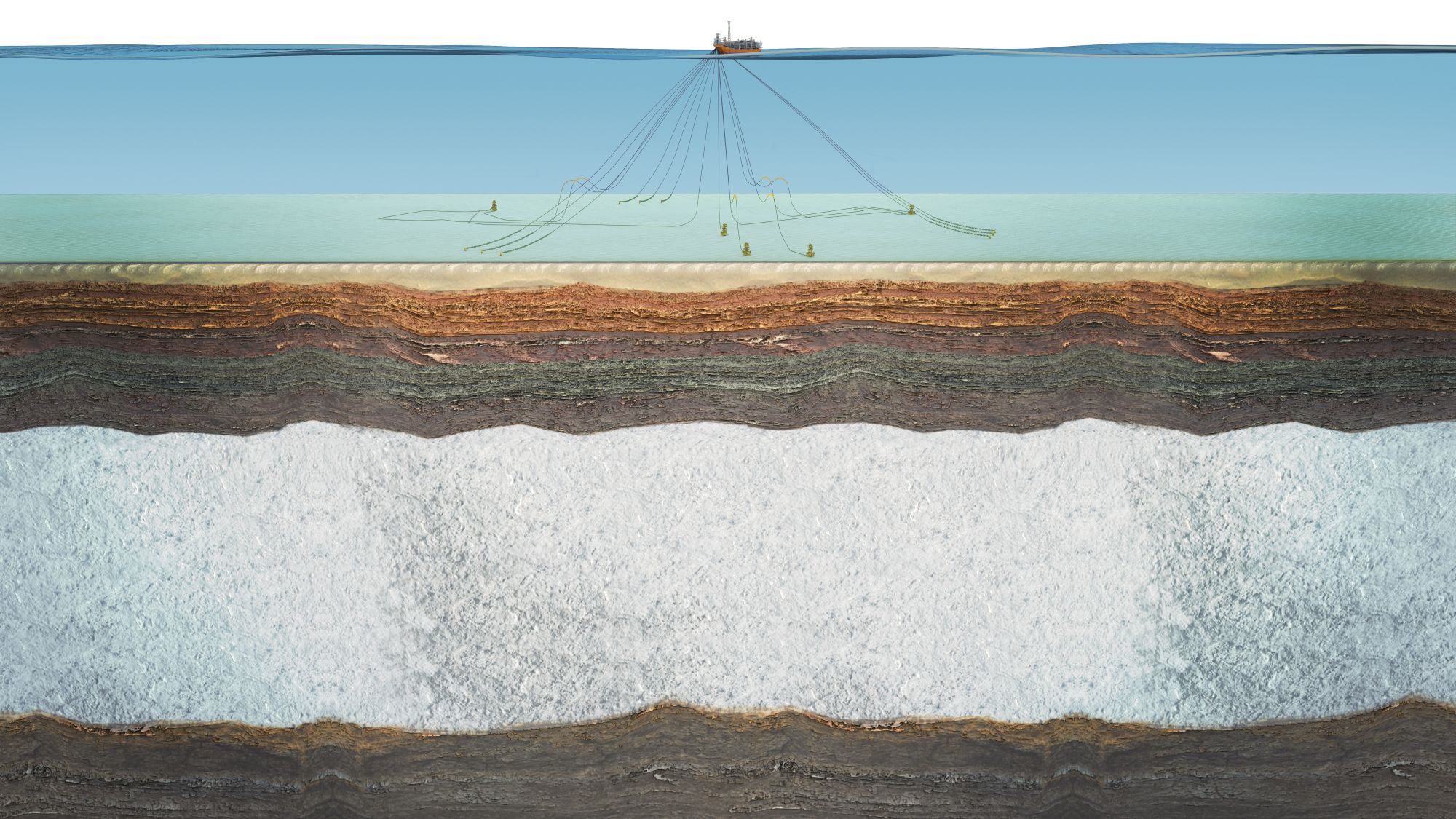
The pre-salt layer is composed of sedimentary rocks that were formed more than 100 million years ago with the separation of the present-day South American and African continents. With this separation, large depressions emerged that gave rise to various lakes, which were later connected to the oceans.
In the deeper regions of these lakes, large quantities of organic matter from microscopic algae began to accumulate. This organic matter, mixed with sediments, formed what are the rocks that generate the oil and gas of the pre-salt.
Shells and calcareous rocks and pre-salt reservoirs
In the shallower parts of these lakes, on large lacustrine islands, the so-called calcareous shells emerged, which accumulated increasingly over time. Later on, these shells "were joined" by stromatolite deposits, which are nothing more than types of algae that form calcareous rocks. Both calcareous shells and calcareous rocks originate the main pre-sal reservoirs.
Due to the arid climate of that time, the intense evaporation of seawater caused the accumulation of salts, which created the pre-salt layer, a kind of protection that prevented oil from "escaping" and reaching the surface.
The total depth of pre-salt reaches 7,000 meters, equivalent to the height of the highest point of the Andes Cordillera! Investments in research and innovations to develop technologies have allowed us to produce oil in the pre-salt.
Production in ultradeep waters incorporates various technologies developed by Petrobras in partnership with the industry:

A system that uses ultrasonic waves and sensors positioned on the seabed to capture three-dimensional data and the temporal variation of fluid behavior in the reservoir. This data enables decisions on drilling strategy and production optimization.

Wells drilled with the objective of precisely mapping the limits of the reservoir and expanding knowledge about its extent and geological characteristics.

A methodology that allows the installation of sensors and real-time monitoring systems for well performance. This approach reduces construction time by approximately 15 days and reduces operational costs.

Developments include Wet Christmas Tree (ANM 2.0), simultaneous water and gas injection systems (WAG loop), and secondary recovery methods with CO2. These systems increase reservoir productivity and recovery factor.

Floating units for storage and transfer of oil with increased capacity. The FPSO Almirante Tamandaré achieved performance of 270,000 barrels/day in 2025. This unit holds certification for reduction of environmental impact in its lifecycle.

The High-Pressure Subsea Separation System (HISEP®) allows capturing CO2 at the moment of extraction and reinjects the gas into the reservoir. The program was recognized as the largest in global scale for CO2 capture and storage.

Additional investments include: supercomputers for processing seismic data and reservoir modeling; artificial intelligence for image enhancement and project optimization; smart uniforms with sensors for safety monitoring; CCUS systems (capture, use, and storage of CO2); virtual reality for field modeling; remote well drilling; electrified platforms with reduction of up to 20% in greenhouse gas emissions; and robots for facility inspection.

The International Energy Agency (IEA) predicts a global demand of 20 million barrels of oil per day in 2050, a volume that has not yet been discovered. Pre-salt exploration enables energy production with safe, efficient, and cost-competitive operation.
Financial returns from pre-salt production contribute to investments in renewable energy sources.
Here we answer some doubts about pre-salt layer
It is a vast province of oil and natural gas reserves located on the seabed, beneath a thick layer of salt. The formation occurred more than 100 million years ago, during the separation of the South American and African continents. The main basins are Santos and Campos.
Pre-salt is a specific geological formation where oil reserves are located.
Production utilizes FPSO-type platforms at depths of up to 7,000 meters. The units extract oil and natural gas, perform storage, and transfer the oil to tanker ships that transport it to onshore terminals. Natural gas is sent through pipelines or reinjected into the reservoir.
The commercial discovery of pre-sal occurred in 2006, off the Brazilian coast. Production began in 2008 in the Jubarte Field, in the Campos Basin, and in 2009 in the Santos Basin.

Utilize nossa busca para encontrar o que procura
Do a search:
Most searched
Fuel price
Pre-salt
Team Petrobras
Do a search:
Most searched
Fuel price
Pre-salt
Team Petrobras
Language:
Select a language:
Accessibility
Choose a channel:


